Non-rigid tumor motion compensation software

Medical hardware, Medical device

UNMET NEED

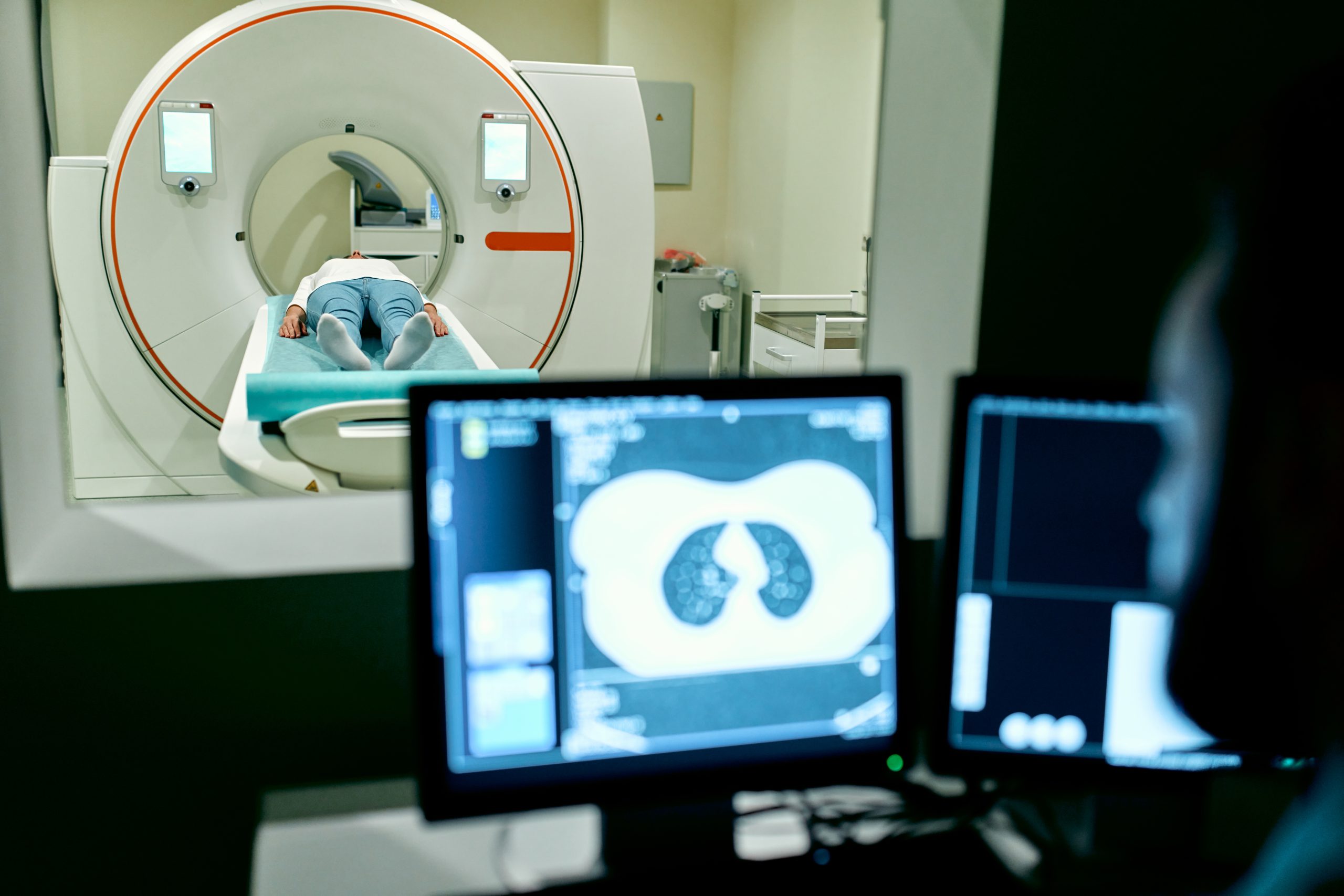
Enabling free-breathing liver cancer therapies such as external beam radiotherapy (EBRT) requires accurate tracking of the internal anatomy and tumor location during treatment to focus radiation beams to targets and spare healthy tissue. However, a major limitation for this type of intervention resides in the patient’s respiration or involuntary movements, which may stray the pre-defined target and trajectories determined during planning from the actual anatomy, thus inducing errors in the relative position of the instrument performing the action with respect to the target. Live motion tracking of the internal anatomy depends on 3D imaging and image postprocessing in real-time, which is difficult to achieve during interventional procedures. Current methods are limited to providing a static intraoperative representation of organ deformation due to real-time constraints. Therefore, clinicians visually measure how the tumor target moves with few intraoperative images, and then use their intuition of the internal motion of the tumor to achieve a proper targeting.
TECHNOLOGY OVERVIEW

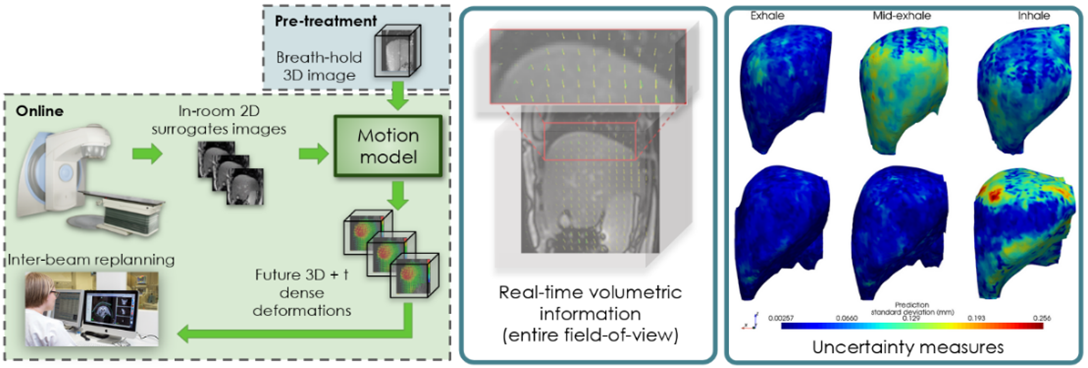
Professor Samuel Kadoury and his team propose a software tool for the motion-compensated reconstruction of a 3D MRI volume from partial 2D cine-MRI images using a conditional variational autoencoder architecture along with a spatial transformation layer. The model they’ve developed seeks to associate phase-specific motion distributions with temporal representations from the sequential 2D images. Once the model is trained, it is able to warp the gated 3D pre-operative acquisition by sampling the deformation conditioned on in-room 2D cine-MRI scans, thereby providing real-time volumetric deformations over the entire anatomy. This can potentially reduce geometric uncertainties during image-guided RT.


COMPETITIVE ADVANTAGES

  • Reconstruction of a 3D MRI volume from partial 2D Cine-MRI images acquired in real-time
  • No prior segmentation or additional manual steps required
  • Improved treatment efficiency and reduced damage to healthy tissues surrounding the target


BUSINESS OPPORTUNITY

  • Technology available for in-licensing
  • Seeking for industrial co-development partner
  • Seeking for research partnering
  • Eligibility to government financing for industry/academic maturation program


IP PROTECTION

CONTACTS

Samuel Kadoury

PRINCIPAL INVESTIGATOR
Full professor
Department of Computer Engineering and Software Engineering
Polytechnique Montreal

Benoit Doré, Ph. D.

CONTACT PERSON
Project Manager, Life Sciences
Axelys
benoit.dore@axelys.ca