Freely explore open world virtual environments

Algorithm, Information & communications technology (ICT)

UNMET NEED

Virtual reality (VR) technology is used in various domains such as gaming, entertainment, education, healthcare, and business. Locomotion is one of the most significant unsolved problems in the field of Virtual Reality (VR). To deliver an immersive and comfortable VR experience, the coupling between physical and virtual motions is critically important. Most VR experiences either restrict user movement within limited “room-scale” spaces (e.g. 4m x 4m) or utilize alternative virtual locomotion techniques that are widely associated with negative effects such as simulator sickness and spatial disorientation such as flying, teleportation, etc.
Redirected walking is a VR locomotion technique which enables users to navigate virtual environments (VEs) that are spatially larger than the available physical tracked space. Limitations of existing techniques, such as warping, introduce visual artifacts and distort the user’s field of view, forcing users to look away by stimulating saccades with the use of flashing spots in screen space, or using accelerated head rotations to redirect the users. These stimulants can be distracting to the user and can result in less immersive user experience.
TECHNOLOGY OVERVIEW

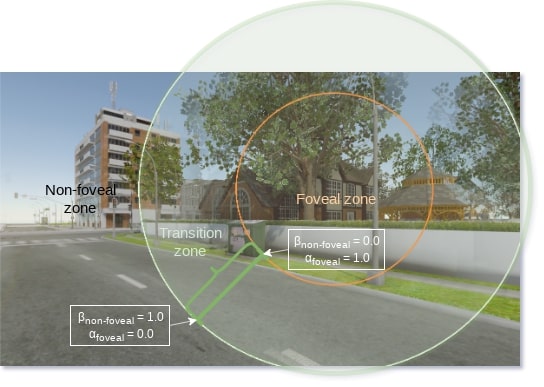
The proposed invention does not redirect the user by warping the VE, stimulation saccades, or using accelerated head rotations. This invention is a novel technique for redirected walking in VR based on the psychological phenomenon of inattentional blindness that is induced by the moderated cognitive task at hand. Based on the user’s visual fixation points, the user’s view was divided into zones.
Spatially varying rotations are applied according to the zone’s importance and are rendered using foveated rendering. It is a real-time technique that is applicable to small and large physical spaces and does not require the use of stimulated saccades but rather takes advantage of naturally occurring saccades and blinks.


COMPETITIVE ADVANTAGES

  • Using natural visual suppressions such as eye blinks and saccades to make subtle rotations to the VE without the user’s knowledge.
  • Not requiring any additional or artificial stimulation to trigger the saccades or blinks to make a redirection.
  • Reducing the overall GPU workload and helps achieve real time performance.
  • Handling long straight walks


MARKET APPLICATIONS

  • VR to explore a VE that is bigger than the available physical tracked space.
  • Gaming, training, and simulation in VR.
  • Exploring the real world in applications such as Google Earth or Google Maps in conjunction with any moderate cognitive task.


BUSINESS OPPORTUNITY

  • Technology available for licensing
  • Seeking for industrial co-development partner/investment
  • Eligibility to government financing for industry/academic maturation program


IP PROTECTION

  • US patent application


CONTACTS

Charalambos Poullis

PRINCIPAL INVESTIGATOR
Professor, Department of Computer Science and Software Engineering
Concordia

Andréa Arias

CONTACT PERSON
Project Director, Business Development
Axelys
andrea.arias@axelys.ca