UNMET NEED
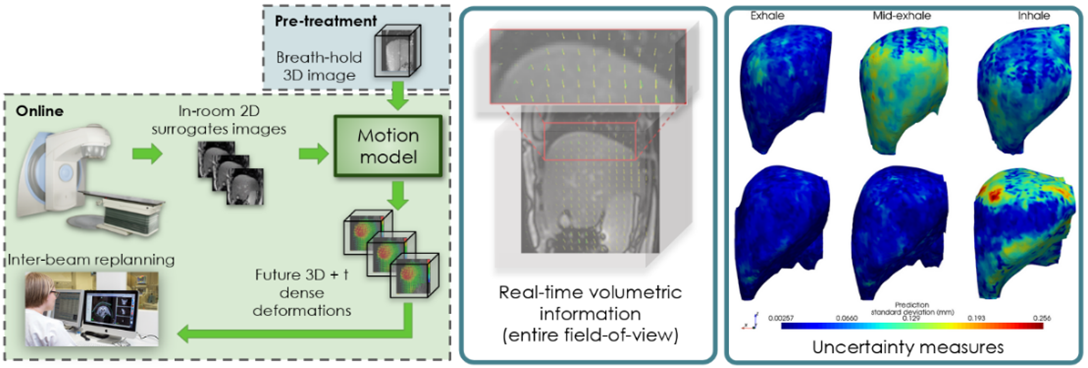
Enabling free-breathing liver cancer therapies such as external beam radiotherapy (EBRT) requires accurate tracking of the internal anatomy and tumor location during treatment to focus radiation beams to targets and spare healthy tissue. However, a major limitation for this type of intervention resides in the patient’s respiration or involuntary movements, which may stray the pre-defined target and trajectories determined during planning from the actual anatomy, thus inducing errors in the relative position of the instrument performing the action with respect to the target. Live motion tracking of the internal anatomy depends on 3D imaging and image postprocessing in real-time, which is difficult to achieve during interventional procedures. Current methods are limited to providing a static intraoperative representation of organ deformation due to real-time constraints. Therefore, clinicians visually measure how the tumor target moves with few intraoperative images, and then use their intuition of the internal motion of the tumor to achieve a proper targeting.